In the perpetual darkness of the deep sea, nature has engineered one of its most mesmerizing adaptations: bioluminescence. Among the myriad of light-producing creatures, the lanternfish stands out not only for its abundance but for the sophisticated biological lanterns that dot its body. These intricate organs, capable of producing light through biochemical reactions, have long fascinated scientists seeking to understand their development, function, and evolution. Recent breakthroughs in genetic engineering have now made it possible to delve deeper into this luminous mystery than ever before.
The application of gene-editing technologies, particularly CRISPR-Cas9, has revolutionized how researchers study biological processes. By leveraging these tools, scientists can now precisely alter specific genes associated with the development of bioluminescent organs in lanternfish. This precision allows for the creation of luminous markers that can trace the cellular and molecular pathways involved in the formation and function of these light-producing structures. The implications are profound, offering a window into the genetic blueprint that governs one of the ocean's most enchanting phenomena.
To appreciate the significance of this research, one must first understand the role of bioluminescence in deep-sea ecosystems. For species like the lanternfish, light serves multiple critical functions. It can be used for camouflage through counter-illumination, where the fish matches the ambient light from above to avoid predators lurking below. It facilitates communication between individuals, perhaps for mating or schooling purposes. It can also act as a lure to attract prey or a warning to deter threats. Each of these functions relies on the precise development and control of bioluminescent organs, which are often complex structures involving photocytes (light-producing cells), reflectors, lenses, and pigment layers.
The genetic basis of these organs has been a subject of speculation and study for decades. Early research identified key genes involved in the synthesis of luciferin (the light-emitting molecule) and the enzyme luciferase, which catalyzes the light-producing reaction. However, the broader genetic network controlling the development, positioning, and regulation of these organs remained largely uncharted. Traditional methods like gene knockout or overexpression were either too crude or too invasive for such delicate investigations, especially in deep-sea species that are difficult to maintain in laboratory settings.
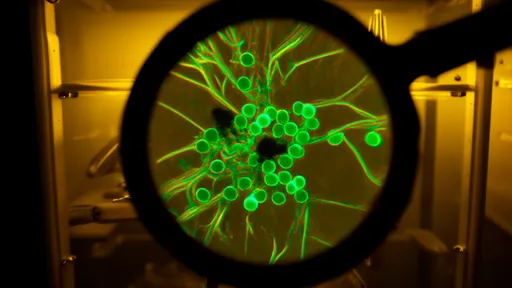
Enter CRISPR-based gene editing, a game-changer in molecular biology. This technology allows for targeted modifications to the genome with unprecedented accuracy and efficiency. In the context of lanternfish bioluminescence, researchers have begun using CRISPR to insert reporter genes—such as those encoding fluorescent proteins—into loci associated with bioluminescent organ development. When these reporter genes are activated, they produce visible signals that can be tracked over time and across tissues, effectively creating a real-time map of how and where these organs form during the fish's development.
One of the most promising applications is the use of biosensor constructs that respond to specific biochemical cues. For instance, genes responsive to calcium ions or neurotransmitters—which are known to regulate light production in some bioluminescent organisms—can be linked to light-emitting reporters. This enables scientists to visualize not only the structural development of the organs but also the activation of signaling pathways that control their function. It's like wiring the fish's luminous system to a dashboard of indicators, each lighting up to reveal a different aspect of its operation.
But the work is not without challenges. Lanternfish, like many deep-sea creatures, are not easily bred or sustained in captivity. Their embryos and larvae are particularly delicate, requiring specialized conditions that mimic the high pressure and cold temperatures of their natural habitat. Advances in aquaculture technology have made it increasingly feasible to maintain these species for research, but it remains a significant hurdle. Moreover, delivering CRISPR components into lanternfish embryos demands innovative techniques, such as microinjection or electroporation, tailored to their unique physiological constraints.
Despite these obstacles, early experiments have yielded exciting insights. For example, editing genes homologous to those known to regulate photophore development in shallow-water species has revealed conserved genetic pathways that might be universal among bioluminescent fish. In other cases, researchers have discovered entirely novel genes that appear unique to lanternfish, suggesting evolutionary innovations specific to the deep-sea environment. These findings not only enhance our understanding of bioluminescence but also contribute to broader fields like evolutionary developmental biology (evo-devo) and ecology.
The potential applications extend beyond basic science. The genes and mechanisms underlying bioluminescence have inspired numerous biomedical and technological innovations. Luciferase genes, for instance, are widely used as reporter genes in molecular biology to monitor gene expression and protein interactions. Understanding how lanternfish achieve such efficient and controllable light production could lead to advances in bioimaging, where brighter and more stable luminescent markers are always in demand. There are even prospects for developing new optogenetic tools—using light to control neural activity—based on the natural light-sensing and producing capabilities of these fish.
Furthermore, this research underscores the importance of conserving deep-sea biodiversity. Lanternfish are a cornerstone of mesopelagic ecosystems, forming massive shoals that are a critical food source for larger predators like whales, squid, and commercially important fish. Their bioluminescence plays a key role in these ecological interactions. As human activities such as deep-sea mining and climate change threaten these fragile environments, understanding the biology of species like lanternfish becomes not just an academic pursuit but a conservation imperative. Genetic tools can help assess population health, track migrations, and predict how these species might adapt to changing conditions.
Looking ahead, the integration of multi-omics approaches—genomics, transcriptomics, proteomics—with gene editing will likely accelerate discoveries. Sequencing the lanternfish genome has provided a roadmap, but it is through functional studies like gene editing that we can test hypotheses and validate gene functions. Collaborations between molecular biologists, ecologists, and bioengineers are essential to tackle the multidisciplinary challenges of this research. Each breakthrough brings us closer to deciphering the full story behind the lanternfish's light.
In conclusion, the marriage of gene-editing technology with the study of bioluminescence marks a new era in marine biology. By turning the lanternfish into a living canvas of genetic markers, scientists are illuminating the darkest corners of developmental biology and ecology. This work not only satisfies human curiosity about one of nature's most spectacular displays but also holds promise for practical innovations that could benefit society. As we continue to explore the depths, both of the ocean and of the genome, the humble lanternfish shines as a beacon of discovery.

By /Aug 27, 2025

By /Aug 27, 2025

By /Aug 27, 2025

By /Aug 27, 2025

By /Aug 27, 2025

By /Aug 27, 2025

By /Aug 27, 2025
By /Aug 27, 2025

By /Aug 27, 2025

By /Aug 27, 2025

By /Aug 27, 2025

By /Aug 27, 2025

By /Aug 27, 2025

By /Aug 27, 2025

By /Aug 27, 2025

By /Aug 27, 2025

By /Aug 27, 2025
By /Aug 27, 2025

By /Aug 27, 2025

By /Aug 27, 2025